 OK
Measurements and rules
When the defect can be measured: width, position, presence. Fast, stable and easy to explain.
Home / Machine vision / Seal
Pack integrity · vision and deep learning
A cold seal or one with trapped product can pass the line and fail at the point of sale. We check the seal on every pack and, using process statistics, alert you when it starts to drift, before the defect appears.

What it does
The camera measures every seal and compares it with its recipe. Where classic vision falls short (reflective surfaces, folds, variable materials) we apply deep learning, with neural networks trained on your good and bad packs. Our Nadir software adds the statistics: mean, spread and bell curve for each measurement, to show whether the process is stable.
Our approach
Not every seal is inspected the same way. In each case we work out which technique gives the reliability you need and tell you before you sign, including anything that can't be guaranteed.
When the defect can be measured: width, position, presence. Fast, stable and easy to explain.
For whatever varies from one pack to the next: folds, reflections, materials or natural products.
Histograms and trends for each measurement, to know whether the sealer is drifting out of adjustment.
If your current system rejects good seals, the false rejects guide explains where they come from. For trays, tubs and bags, see also machine vision for the food industry.
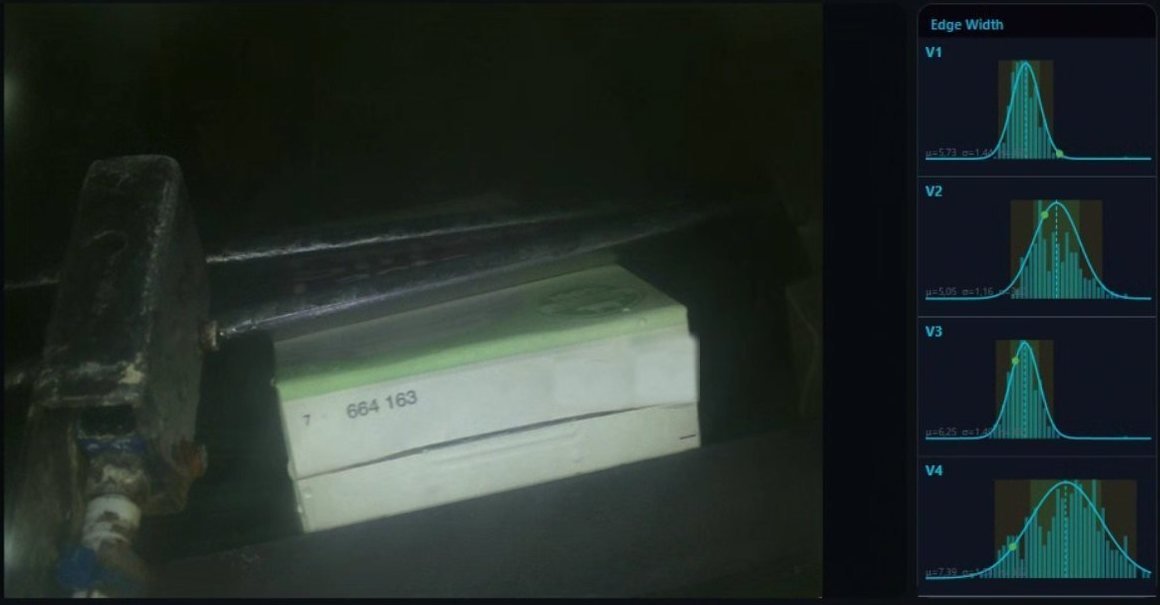 Carton pack · seal
With Nadir we detect sealing problems on the bottom of carton packs using deep learning, and process statistics anticipate drift before it turns into defects.
Daily seal statistics
Every day, without anyone asking, our software emails quality and the shift supervisors a summary of how the packs were sealed, lane by lane. This is what one looks like for a production day of carton packs, with over 200,000 packs checked one by one.
 SentinelPLUSNadir mode
📊 REPORT BY LANE
LINE 00 XX · 12/05/2026
214,737 packs · 3 NOK
Tuesday 12 May 2026 · 0.00% rejected
Lane 4 rejects the most: 0.00% (2 of 48,410).
| Lane | Packs | NOK | % rejected | Mean | σ | CV | Cpk | Min – Max |
|---|---|---|---|---|---|---|---|---|
| Lane 1 | 48,120 | 0 | 0.00% | 4.72 | 1.21 | 25.6% | 3.11 | 0.35 – 12.90 |
| Lane 2 | 48,305 | 0 | 0.00% | 4.31 | 1.08 | 25.1% | 3.61 | 0.42 – 11.20 |
| Lane 3 | 48,262 | 0 | 0.00% | 4.95 | 1.24 | 25.1% | 2.97 | 0.38 – 11.84 |
| Lane 4 | 48,410 | 2 | 0.00% | 5.38 | 1.33 | 24.7% | 2.66 | 0.51 – 12.35 |
Diagnosis
All 4 lanes behave consistently: similar spread and centring, none standing out.
Capability measured against the limits — / 16. Cpk ≥ 1.33 capable · 1.00–1.33 marginal · < 1.00 not capable.
21,640 packs with no lane assigned (the machine was starting up or the trigger pattern was lost): not attributed to any lane.
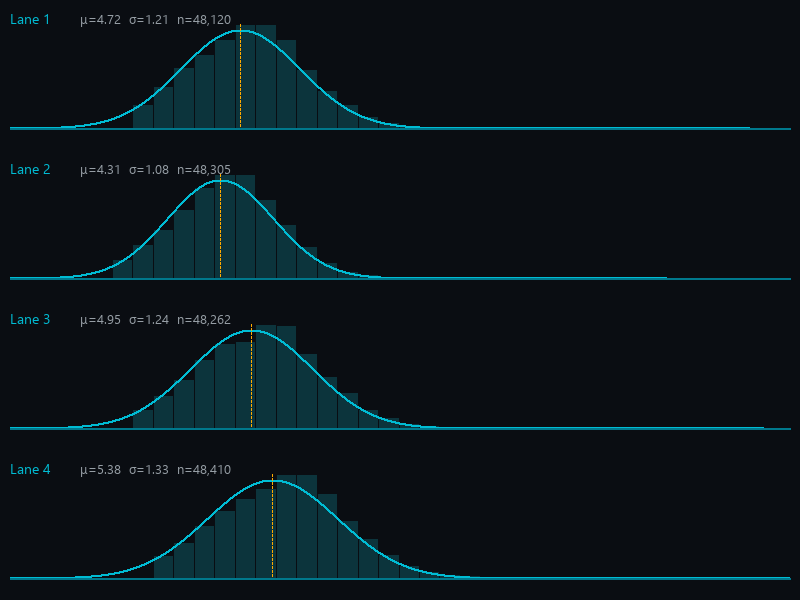
Distribution of the measurement by lane
Measurement through the day
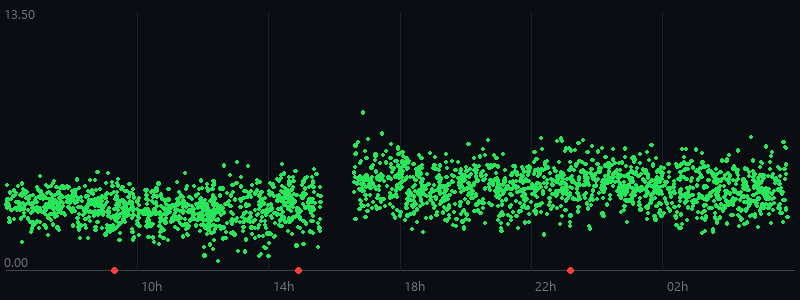
Green: good pack · Red: rejected.
TIVOX Solutions · Automatic message from the plant, do not reply
Packs checked, rejected and the reject rate, in one line. The first thing the shift supervisor sees on opening the email.
If one sealing head starts failing more than the others, it is highlighted at the top, with its percentage and count.
Each sealing head separately: mean and spread (σ) of the measurement, coefficient of variation (CV), minimum and maximum.
Compares the spread with the tolerance limits. Above 1.33 the process is capable; here every lane is between 2.6 and 3.6: a very stable seal.
The system compares the lanes and spells it out: the best, the worst and whether any has drifted. No spreadsheets.
Each lane's histogram with its normal curve. If a curve widens or shifts, the sealer is drifting out of adjustment, even before any rejects.
Each dot is a pack. You can see start-ups, shift changes and drifts, and in red every reject at the exact moment it happened.
Each report also includes a photo of the rejected packs. Recipients, time and frequency (per shift, day or week) are set for each plant.
FAQ
A camera with its lighting, placed on the line after the sealer, that measures the seal of every pack and compares it with its recipe. If the seal is out of range, the pack is rejected with its photo. With the process statistics, it also warns you when the sealer starts to drift, before the first defect.
The width and continuity of the seal, product trapped in the seal, creases and folds, and bottom seals and openings on carton packs. Where classic vision falls short (reflections, folds, variable materials), we apply deep learning.
Sampling checks a few packs from time to time, and they are usually destroyed; whatever happens between one sample and the next goes unseen. The camera checks the seal of every pack without touching it, and the process statistics warn you when the sealer starts to drift, before the first defect.
Packs with a weld or heat seal, such as cartons and carton packs, bags, blisters or tubs, depending on the case. In the feasibility test we look at your specific pack and tell you whether it can be inspected reliably.
No. If the defect can be measured, classic vision is simpler and more stable. We reserve deep learning for what classic vision doesn't handle well.
Nadir records every measurement and calculates its mean and spread. When the trend moves outside normal limits the alarm goes off, even if no packs have been rejected yet.
They are removed from the line, and every reject is stored with its photo, time and reason, available to quality and for any audit or complaint.
Free remote feasibility test
Send us good and bad samples. We'll tell you which technique works with your pack and with what expected reliability.