 OK
Batch and expiry date
Reading (OCR) and verification (OCV) of batch and date against the production order. An alert when the print head starts to degrade, before a character becomes unreadable.
Home / Machine vision / Pharma
Pharma · Batch · DataMatrix
On a pharma line, a badly printed batch number, an unreadable code or a carton carrying another product's label is not just waste: it is a batch on hold. With machine vision we check every unit, and any unit that fails is rejected with its photo and its reason.
What we check
Checks that can be installed separately or together, depending on where the problem starts on your line: at the coder, at the labeller, at the closure or at the end, in the case.
Reading (OCR) and verification (OCV) of batch and date against the production order. An alert when the print head starts to degrade, before a character becomes unreadable.
Reading and print quality grading of the code, and a match against the product being packed.
Every carton, bottle or blister carries the label of the current SKU, present, straight and in position. A carton from another SKU is rejected even if it is correctly printed.
Cap present, straight and at the right height, and the seal or tamper-evident closure intact and correctly fitted.
Welds and heat seals with trapped product, creases or incomplete sealing, depending on the pack; with deep learning when the defect varies from one unit to the next.
The number of units in every case or bundle, so that none leaves incomplete for the warehouse or the distributor.
Serialisation
In the European Union, prescription medicines carry a unique identifier in a GS1 DataMatrix code and an anti-tampering device (Commission Delegated Regulation (EU) 2016/161). The pharmacy reads that code before dispensing: if it cannot be read, the pack does not go out.
Your serialisation system generates and records the numbers. On the line we check what that system does not see: that every printed code can be read, with which quality grade, and that it carries the data of the current product and batch. If print quality starts to drop, you know before a code becomes unreadable.
Mix-ups
A carton from the previous SKU left behind in the labeller, or the wrong roll of labels after a format changeover: these faults are rare, but a single unit is enough to recall a batch.
That is why each format has its own recipe, and the recipe knows which label, which text and which code belong to that SKU. At the format changeover the new recipe is loaded in seconds and, from the very first unit, anything that does not match it is rejected with its photo. Line clearance remains your procedure; the camera is the check that does not tire on the last shift.

How it decides
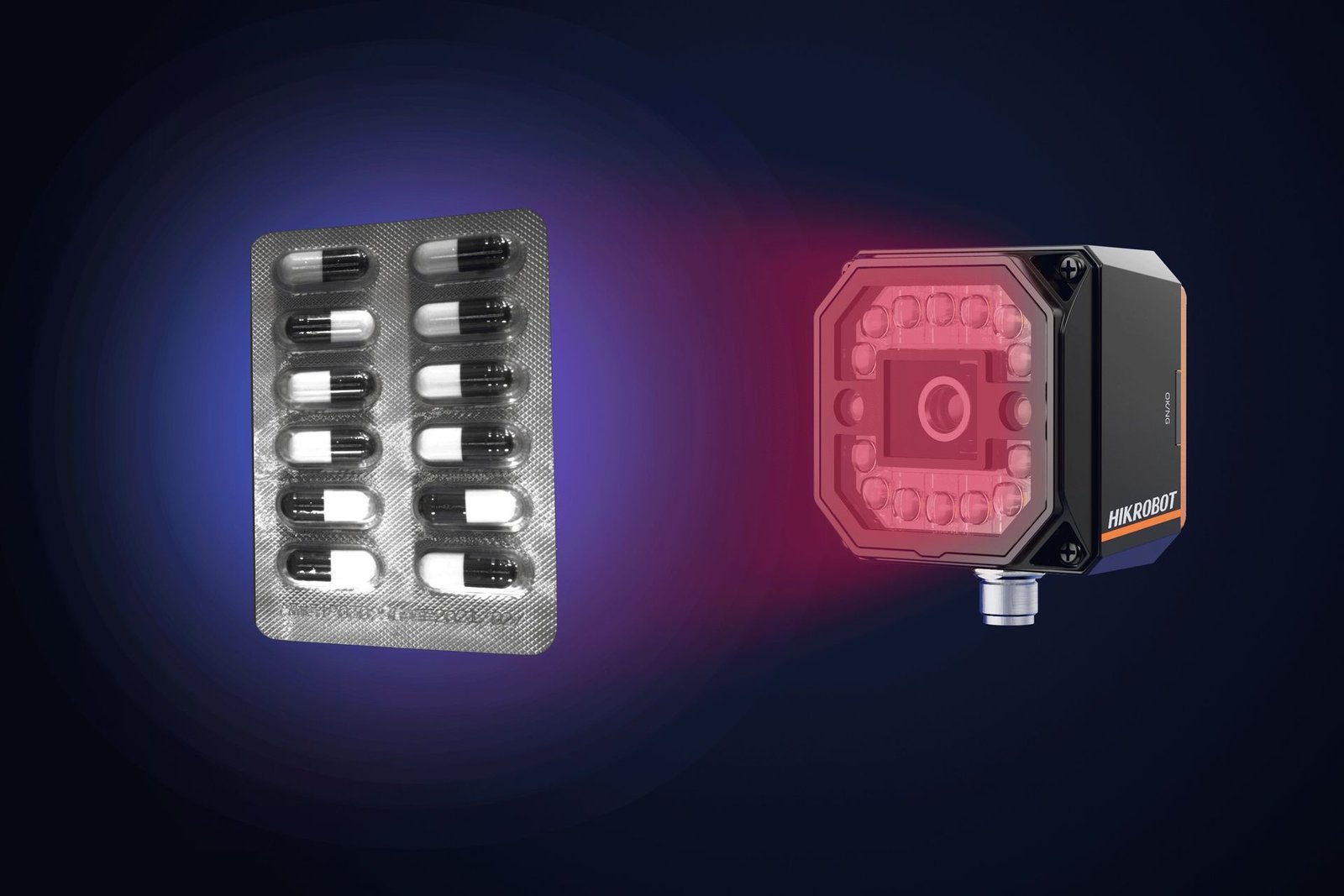
HIKROBOT smart cameras with on-camera processing. Each format has its own recipe: which areas to inspect, with which tool and which threshold. If anything falls out of range, the unit is rejected and its image is stored with the exact reason.
Why it matters
In pharma, every decision on the line has to be provable. With every reject stored with its image, time, recipe and reason, and every threshold change logged, an audit or a complaint is answered with data. We help you comply.
Operator, maintenance and read-only, each with what they are allowed to do. Nobody changes a threshold without leaving their name.
The limits of each recipe and their change history, on demand, for quality and for the auditor.
Reject images are kept for the whole shelf life of the product: a complaint a year from now is answered with the photo.
More on each check: date and batch, labels and DataMatrix codes, caps and closures and counting in cases. If your current system rejects good units, the false rejects guide explains where they come from. Before asking for quotes, the guide to choosing a machine vision system goes through the questions that decide the system.
How to get started
Before installing anything, we know whether your defect can be detected and with what reliability.
FAQ
To check every unit on the line, not a sample: that the batch and expiry date are printed correctly, that the GS1 DataMatrix code can be read and with what quality grade, that the label and carton belong to the current SKU, that the closure and tamper-evident seal are in order, and that every case contains all its units. Every unit that fails is rejected with its photo and its reason, and that record serves as evidence in an audit or a complaint.
HIKROBOT smart cameras, with processing on the camera itself. Each format has its recipe, and they are integrated with the line through digital I/O or Modbus TCP, without changing the machine.
Batch and expiry date (reading and verification), reading and quality grading of the GS1 DataMatrix, the right label and carton for the SKU, cap and seal, sealing of blisters and sachets depending on the pack, and the number of units per case.
No. Your serialisation system generates and records the serial numbers. Machine vision checks on the line that every printed code can be read, with what quality and with the data of the current batch, and rejects the unit that fails.
Yes. Every rejected unit is stored with its image, time, recipe and reason, and threshold changes are logged with the user who made them. Reject images are kept for the whole shelf life of the product.
Each format has its own recipe, with the label, text and code that belong to it. When the new recipe is loaded, any unit that does not match it is rejected from the very first one, even if it is correctly printed.
No. The camera connects to the line through digital I/O or Modbus TCP, and the rejecter acts on the unit that fails.
We run a remote feasibility test at no cost: you send us photos, videos or samples of your good and bad packs (if a visit to your plant is needed, travel is charged separately). What cannot be guaranteed, we tell you up front.
Free remote feasibility test
Send us samples of your packs. We'll tell you what can be checked in-line and with what expected reliability.