 OK
What does it have to detect?
An illegible date, a crooked cap, a seal with trapped product, a label from another SKU. The more specific, the better: ideally, you have real good and bad packs.
Home / Machine vision / How to choose a system
Guide · Industrial machine vision · Buying
A machine vision system is not chosen by its camera. It is chosen by what it has to detect, at what speed, across how many formats and what happens to each rejected pack. In this guide we go through the questions worth answering before requesting quotes, the parts of a system and how to compare proposals without surprises at commissioning.
Before looking at cameras
With these answers, any serious supplier can tell you whether your case is feasible and what you need. Without them, you are comparing blind.
An illegible date, a crooked cap, a seal with trapped product, a label from another SKU. The more specific, the better: ideally, you have real good and bad packs.
A complaint, a batch recall or a lost customer. And the other way round: what it costs to throw away good packs. Those two figures set how demanding the inspection needs to be.
Packs per minute or per hour, and how they arrive: spaced or touching, in single file or rotated. The speed decides the camera, the lighting and the rejector.
Each one will have its own recipe. If you change format several times a week, a changeover has to mean loading another recipe, not calling a technician.
Right after the point where the problem originates: after the coder, the labeller, the capper or the sealer. And with room for the camera, the light and the rejector.
Rejecting it without stopping the line, saving its photo and the reason, and alerting someone. A system that detects but neither rejects nor records only does half the job.
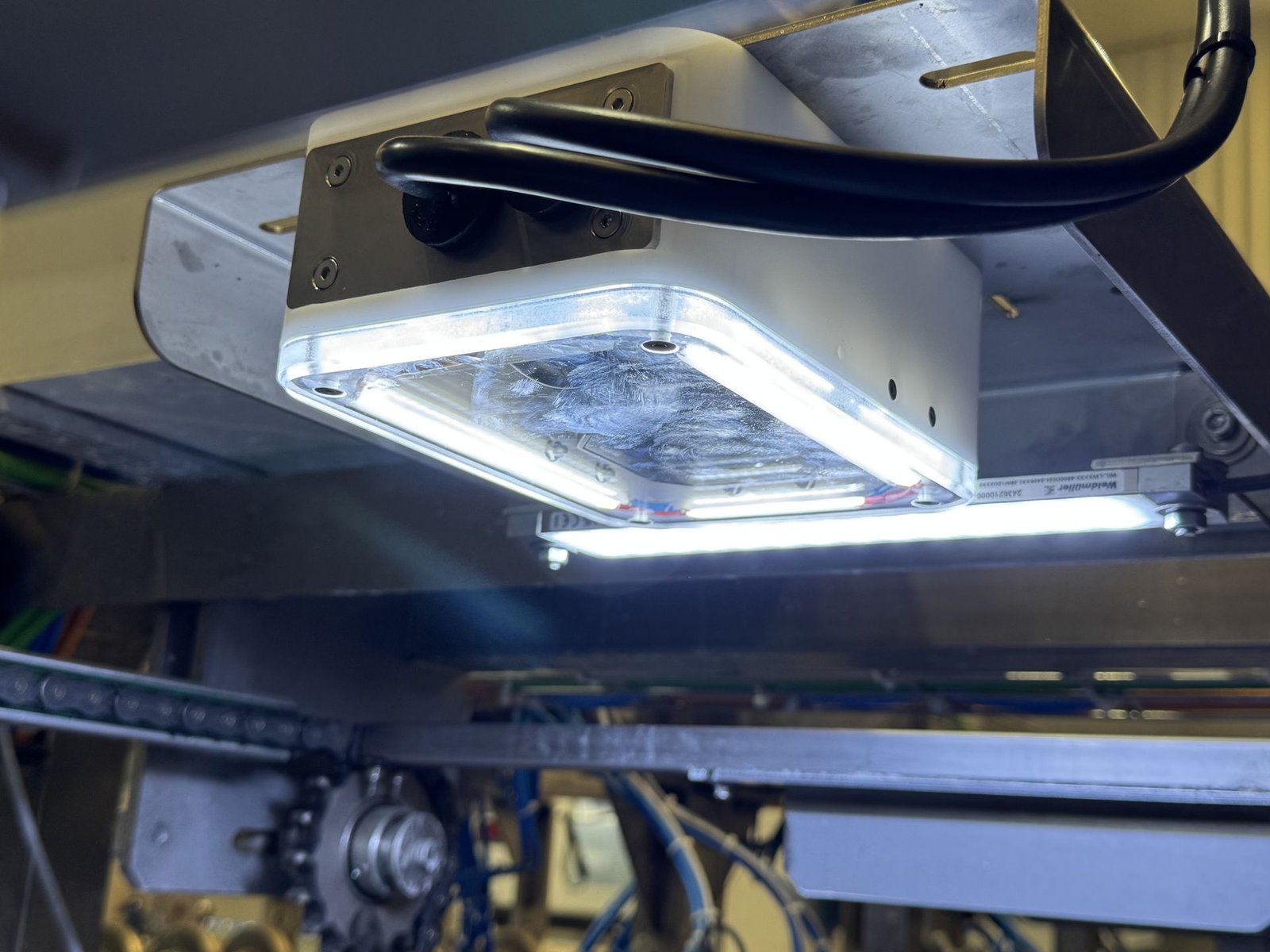
The parts
When an inspection fails, it is hardly ever because of the camera. It is usually the light, the position of the pack, the threshold or the recipe. That is why it pays to look at the whole system:
Two technical decisions
There is no single best answer for everything: it depends on the defect and the line.
A smart camera processes the image inside the camera itself: it is compact, fits in little space and each inspection point is independent. A PC-based system centralises several cameras and handles heavier processing. For most packaging checks (date, cap, label, code, seal), one smart camera per point is enough.
Classic vision measures and compares using rules: it is fast, stable and easy to explain, ideal for measurements and reading. Deep learning learns from good and bad examples and fits when the defect varies from one item to the next (creases, reflections, natural products). Many lines use both.
What gets forgotten when buying
During the test, everything works. The differences between systems appear with daily use, format changeovers and the night shift.
How to compare quotes
Two quotes with the same camera can give very different results. What sets them apart shows up in a test with your product.
If you want to see how you work with a system like this, in the TIVOX Sentinel PLUS simulator you can configure an installation, trigger faults and see the reject gallery. And by sector: food, beverages and pharma.
FAQ
It depends on the number of inspection points, the type of check, the lighting, the rejector and the integration with the line. The usual approach is to start with the point that causes the most problems, measure the result and expand afterwards. A specific figure is given after studying your case.
Yes, that is the most common case. The camera is mounted on the existing line and communicates with it through digital signals or Modbus TCP; the rejector acts on the pack that does not comply.
For most packaging checks, one smart camera per inspection point is enough and simpler to install. A PC-based system makes sense when there are many cameras to coordinate or very heavy processing.
It depends on the defect, the pack and how it reaches the camera. That is why reliability is estimated with a test using your good and bad packs, and what cannot be guaranteed is stated before signing.
When the defect or the product naturally varies from one item to the next and is hard to describe with fixed rules. For measurements, presence checks and clear reading, classic tools are usually faster and easier to adjust.
Yes. We carry out a remote feasibility test at no cost: you send us photos, videos or samples of your good and bad packs (travel to your plant is not included) and we tell you what can be checked in line.
Free remote feasibility test
Send us photos, videos or samples of your good and bad packs. We tell you what can be checked, with what reliability to expect and what cannot be guaranteed.